
About
Gallery
Midis
Links
Site Map
IBM OS/2
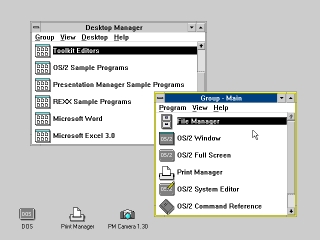
OS/2 got its start in 1985 when IBM and Microsoft joined forces to create a next generation operating system intended to be a protected mode successor to IBM PC DOS. However, when IBM and Microsoft began to move apart both in terms of culture and vision, the two companies eventually parted ways with Microsoft focusing their prior development relating to OS/2 3.0 into what would ultimately become Windows NT. IBM was thus left to continue all OS/2 development on its own. OS/2 1.3, mostly developed by IBM, featured an updated version of the Presentation Manager user interface as well as support for HPFS, which featured many improvements over the older FAT file system such as mixed case and long (255 characters) file names.
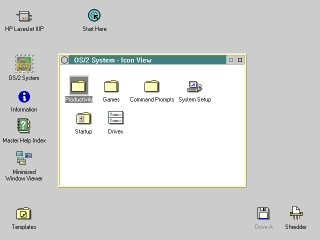
OS/2 2.0, released in April 1992, represented a major leap forward. OS/2 2.0 was a (mostly) 32-bit operating system that provided a 32-bit API for native programs. It also introduced an all new, object oriented user interface called Workplace Shell (WPS). In WPS, everything was represented as an object, and the user could interact with those objects by clicking, dragging, and dropping. IBM referred to OS/2 2.0 as The Integrating Platform, which was a reference to its ability to run DOS, Windows, and OS/2 1.x applications as well as all new, 32-bit OS/2 software. OS/2 2.0 achieved this feat through the use of the Intel 80386's virtual 8086 mode, which allowed the processor to create 8086 virtual machines in which to run DOS (and other operating systems) programs.
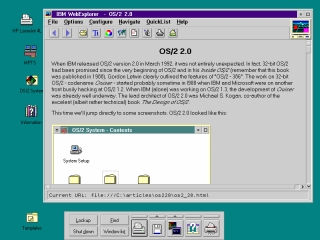
OS/2 3.0, officially named OS/2 Warp, was released in October 1994 and represented yet another major leap forward for the operating system. Much of the remaining 16-bit code was updated to 32-bit, which brought along serious performance benefits. OS/2 Warp also had better hardware support, multimedia capabilities, and improved networking. It was primarily available in two variants: "Red Spine" and "Blue Spine". Red Spine was intended for systems that already had Microsoft Windows installed and could utilize such a preexisting installation to support Windows applications. Blue Spine included Windows support for installation on systems that did not already have Microsoft Windows installed. IBM also included a basic office suite called IBM Works with OS/2 Warp that included word processing, spreadsheet, and database software.
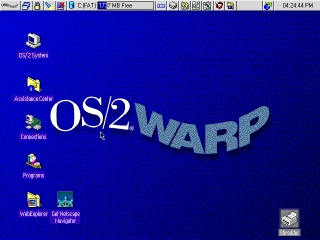
OS/2 Warp 4, released in 1996, received a major update to its user interface, Workplace Shell. IBM also added Java and speech recognition in Warp 4. With Java support, Warp 4 became the first operating system that could run Java applications out-of-the-box. As tensions continued to mount between IBM and Microsoft, IBM purchased Lotus SmartSuite, which was a direct competitor to Microsoft Office and included word processing, spreadsheet, and graphics software. IBM released their final update to OS/2, Warp 4.52, in December 2001 and finally ended support for the operating system on December 31, 2006.
Return to Operating Systems | Return to Gallery



Visitors since ID4, 2025
(You didn't really think I'd forget the 90s-style hit counter?)